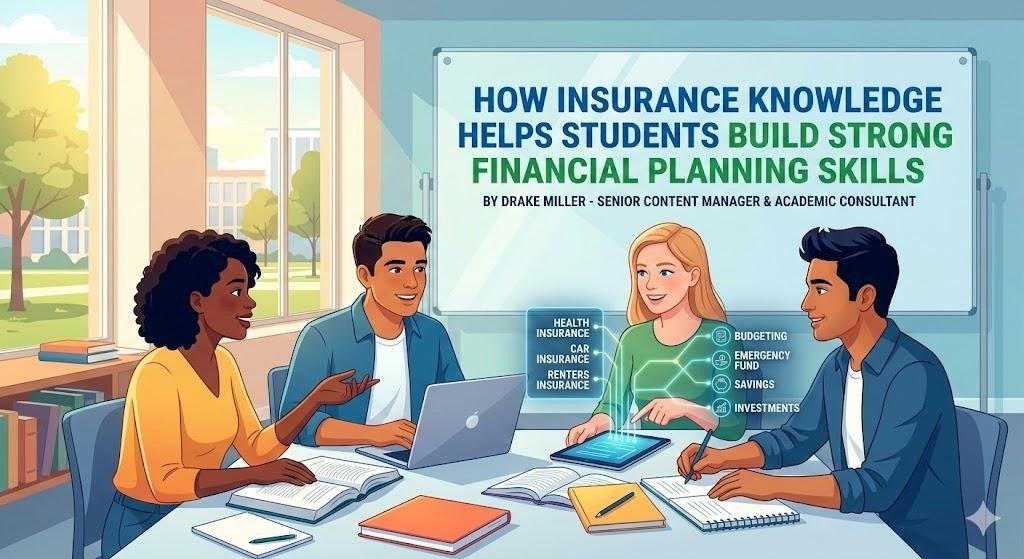
By Drake Miller – Senior Content Manager & Academic Consultant
For many high school and university students in the United States, “financial planning” often brings to mind immediate, tangible concerns: budgeting for overpriced textbooks, saving for a reliable first car, or managing a part-time paycheck from a campus job. However, as an academic consultant who has spent over a decade observing student success trends, I have seen one critical pillar of a robust financial foundation frequently overlooked: insurance.
While it may seem like a concern for the distant future, understanding risk management early is a transformative skill. It is the difference between a minor setback and a total academic derailment. Integrating insurance knowledge into a student’s financial literacy toolkit allows them to transition from simply managing money to actively protecting their future earning potential. In an era of rising tuition and economic volatility, insurance isn’t just a monthly bill—it is a strategic asset for the modern scholar.
1. The Shift from Budgeting to Risk Management
Standard financial advice for students typically focuses on the “inflow and outflow”—ensuring expenses do not exceed income. While essential, this approach is incomplete. Professional financial planning isn’t just about what you save; it is about what you keep when the unexpected happens.
In the U.S. economic landscape, a single uncovered medical emergency or a car accident can disrupt an entire semester of progress. When a student understands the mechanics of a deductible or the value of a renter’s insurance policy, they are learning to account for “financial shocks.”
This shift in mindset helps students build more resilient budgets that include emergency funds. By mitigating risk, students ensure that a stolen laptop or a minor injury doesn’t negatively impact their FICO credit score or lead to a cycle of high-interest debt that persists long after graduation. For students juggling these complex real-world variables alongside their studies, Myassignmenthelp.com provides the structural support needed to maintain academic excellence while mastering life skills.
2. Protecting Your Most Valuable Asset: Earning Potential
For a student, their greatest financial asset isn’t a bank balance; it is their future career. For those heading into high-demand fields such as engineering, medicine, or data science, potential lifetime earnings are in the millions. Understanding disability and life insurance—even in a theoretical sense—highlights the importance of protecting one’s ability to work.
By learning about these concepts early, students can make more informed decisions regarding student loans and employment benefits packages. They begin to view insurance not as an “extra cost,” but as a safeguard for the years of tuition and effort they are investing in their degrees. This perspective is vital for high schoolers heading into college and university students preparing to enter the professional workforce. It reframes insurance as a way to “insure” the return on investment (ROI) of their education.
At the same time, strong academic communication skills play an important role in understanding such complex financial topics. Many students rely on English assignment help to improve their analytical writing and research abilities, allowing them to explain financial concepts like insurance, risk management, and long-term investment planning more effectively in their coursework.
3. The Math of Long-Term Wealth Building
Insurance is essentially the “math of uncertainty.” When students dive into how premiums are calculated and how risk is pooled, they sharpen their general financial numeracy and analytical skills—skills that are directly transferable to high-level academic assignments and professional data analysis.
- Compound Interest vs. Risk: Students learn that losing $2,000 to an uncovered medical expense can be more damaging to their long-term wealth than the benefit of saving that same $2,000 over two years.
- Cost-Benefit Analysis: Evaluating different insurance plans (e.g., High Deductible Health Plans vs. Low Deductible plans) mirrors the logic needed for evaluating investment opportunities or mortgage terms later in life.
4. Navigating the “Real World” with Confidence
The transition from being a dependent to an independent adult is fraught with complex bureaucracy. In the USA, students who possess insurance literacy are less likely to be overwhelmed by these hurdles:
- Health Insurance & The ACA: Understanding “out-of-pocket maximums,” “co-pays,” and “provider networks” is essential. Many students remain on their parents’ plans until age 26 under the Affordable Care Act (ACA), but knowing when to transition to a school-sponsored plan or an employer’s plan is a critical life skill.
- Auto and Renter’s Insurance: Knowing how to shop for quotes prevents students from being “under-insured” during their most vulnerable financial years. For those living in dorms or off-campus apartments, renter’s insurance is often an incredibly affordable way to protect thousands of dollars in electronics and personal property.
- Tuition Insurance: A growing trend in U.S. universities, this allows families to recoup tuition costs if a student is forced to withdraw for medical or mental health reasons—a perfect example of niche risk management.
See also: strategic business analysis report
5. Cultivating a Proactive Financial Mindset
Perhaps the greatest benefit is the psychological shift. Insurance knowledge fosters a proactive rather than reactive mindset. Instead of waiting for a crisis to occur, students learn to identify potential risks and mitigate them before they manifest. This proactive stance is the hallmark of successful financial planners, entrepreneurs, and academic leaders.
When students apply this level of critical thinking to their studies—whether they are tackling complex mathematical models or writing detailed case studies—they demonstrate a higher level of maturity. For those who find the technicalities of these financial concepts challenging, seeking expert academic assistance can help bridge the gap, ensuring they master the quantitative analysis required for modern degrees.
Quick Reference: 3 Insurance Policies Every U.S. Student Needs
| Policy Type | Why It Matters for Students | Key Term to Know |
| Health Insurance | Prevents bankruptcy from medical bills. | Out-of-Pocket Maximum |
| Renter’s Insurance | Covers stolen laptops/phones and liability. | Replacement Cost Coverage |
| Auto Insurance | Required by law and protects your car. | Liability Limits |
Frequently Asked Questions
Q.1 Is renter’s insurance worth it for a college student living in a dorm?
Absolutely. While many students assume their parents’ homeowners insurance covers them, these policies often have high deductibles. Renter’s insurance is specifically designed for students; it is highly affordable and covers expensive electronics like laptops and smartphones against theft or accidental damage.
Q.2 How does the Affordable Care Act (ACA) affect health insurance for students?
Under the ACA, most students can remain on their parents’ health insurance plans until the age of 26. However, if you are attending a university out-of-state, you must verify that your plan’s “provider network” includes doctors and hospitals near your campus to avoid high out-of-network costs.
Q.3 What is “Tuition Insurance,” and do I actually need it?
Tuition insurance refunds your tuition and fees if you are forced to withdraw from the semester due to a covered medical reason. For students at high-tuition private universities, this prevents a medical crisis from becoming a permanent financial disaster.
Q.4 Can insurance knowledge help improve my credit score?
Indirectly, yes. Unpaid medical debt or accident collections are major threats to a student’s credit. Having the correct insurance ensures these “shocks” are handled by the carrier, protecting your FICO score as you prepare for post-graduation life.
Conclusion
Financial planning is a multi-dimensional discipline, and insurance is its protective shield. For students in high school and beyond, gaining a firm grasp of insurance today ensures that the wealth they work so hard to build tomorrow remains secure. As we move into an era defined by AI-powered personalization and shifting economic trends, those who understand risk will always be one step ahead of those who only understand savings. Mastering these concepts provides the analytical edge required for both academic excellence and lifelong financial independence.